Study: Tidally Locked Exoplanets May Maintain Habitable Regions Through Internal Heat Circulation
07/13/2026 / By Edison Reed
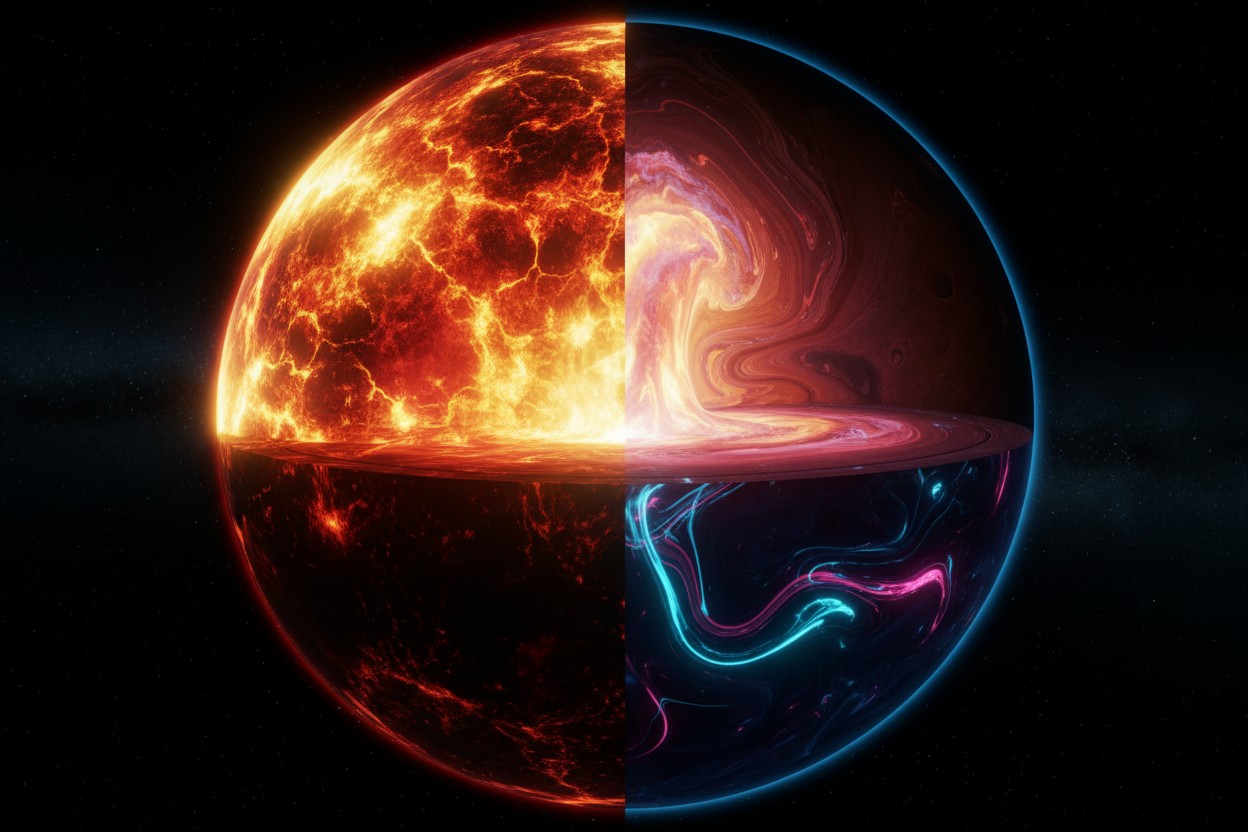
LHS 3844b, an exoplanet 48.5 light-years from Earth, has one hemisphere locked in eternal daylight while the other remains in permanent darkness. Daytime temperatures on this tidally locked world can reach 1,000 to 2,000 Kelvin, according to researchers, while the night side approaches absolute zero. A study published July 9, 2026 in Nature Communications suggests that internal heat circulation within such planets could create moderate zones suitable for life.
Daisuke Noto, a postdoctoral researcher in Hugo Ulloa’s Penn GEFLOW Lab at the University of Pennsylvania, led the investigation. The team built a laboratory model using a tank of viscous glycerol and thermochromic liquid crystals to simulate mantle convection. Their findings indicate that tidally locked exoplanets may be more hospitable than previously assumed, because heat can be redistributed laterally beneath the surface.
Background and Prevalence of Tidally Locked Worlds
Tidally locked planets rotate once on their axis for every orbit around their star, causing one side to face the star permanently. According to Noto, worlds with permanent day and night are much more common than planets like Earth that experience regular day-night cycles. Many celestial bodies, such as moons and planets very close to their parent stars, are tidally locked. This alignment creates extreme temperature contrasts: The sunlit side can reach temperatures hot enough to melt rock, while the dark side plunges near absolute zero.
Previous scientific assumptions held that such extreme environments made life impossible. However, the new study challenges that view. As Noto stated, “Just looking at the extreme temperatures on the day and night sides might lead one to conclude these exoplanets are too harsh for life. But life might find a way.” The prevalence of red dwarf stars in the galaxy means that tidally locked planets are among the most common types of exoplanets [2]. Books on astrobiology have noted that M-dwarf stars can last for trillions of years, providing long timescales for potential development of life on surrounding planets [5]. Additionally, the search for life-friendly planets has considered tidally locked worlds as potential candidates if they can maintain temperate conditions [6].
Researchers from Arizona State University have previously studied the TRAPPIST-1 system, which contains seven Earth-sized planets orbiting a red dwarf, though those worlds may be too wet for life [1]. The new findings add a different perspective by focusing on internal heat circulation rather than surface water alone.
Laboratory Model and Observed Heat Circulation
Rather than relying solely on computer simulations, the research team built a physical laboratory model to mimic the interior of a tidally locked planet. Noto joked, “Building an actual exoplanet in the lab wasn’t in the budget.” Instead, the researchers used a tabletop rectangular tank filled with viscous glycerol and tiny thermochromic liquid crystals that change color as temperatures shift. Similar experimental systems have long been used to study how heat moves through slow-moving materials, making them useful stand-ins for rocky planetary interiors.
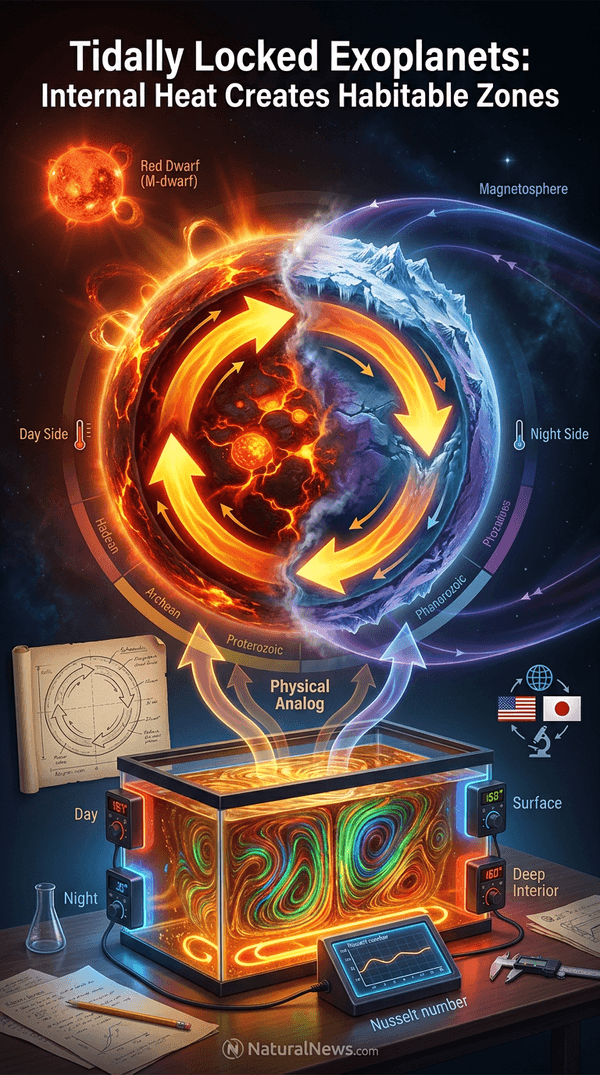
The team installed four thermostats around the tank to heat and cool different regions, creating temperature gradients similar to those between the permanently illuminated side, the permanently dark side, the surface, and the deep interior. The experiments revealed a remarkably stable pattern. Hot material consistently rose beneath the day side, flowed across the upper region, cooled as it reached the night side, then sank before returning through the lower mantle. This created one continuous circulation loop. Noto described the pattern as “slow and steady” and “kind of boring — but in a good way.”
Measurements of heat transport, known as Nusselt numbers, were comparable to those seen for Earth’s mantle. That finding suggests some tidally locked exoplanets could maintain localized geothermal environments that provide conditions favorable for life, particularly in more temperate mid-latitudes. Similar heat-driven convection processes have been studied in the context of Earth’s own interior dynamics, where slow creeping flow governs mantle behavior [4].
Implications for Habitability and Future Research
The steady circulation pattern may do more than moderate surface temperatures. Noto stated that it could also influence the movement of a planet’s liquid core, potentially generating magnetic fields that differ from Earth’s familiar dipole field. He noted, “That’s something we couldn’t test in this experiment, but it’s an exciting direction for future work.” Magnetic fields are considered important for shielding potential life from stellar radiation, particularly around red dwarf stars that are known to produce frequent flares [2].
The research was conducted by scientists from the University of Pennsylvania, the Japan Agency for Marine-Earth Science and Technology, and Hokkaido University. Noto and Ulloa are continuing to develop similar laboratory models to investigate a range of geophysical processes. Earlier research from the Penn GEFLOW Lab explored how heat and mass move through confined spaces, providing insight into fluids in hydrothermal systems. Noto said, “We are planning on further extending the experimental methods to delve deeper into different systems on our planet in different contexts, the possibilities are, quite literally, out of this world.”
Conclusion
The study indicates that tidally locked exoplanets may be more hospitable than previously thought due to internal heat redistribution. The findings rely on a physical laboratory model rather than computer simulations alone, providing empirical support for the idea that subsurface convection can create moderate thermal environments. This challenges the assumption that planets with permanent day and night cannot support life.
The research was conducted by scientists from the University of Pennsylvania, the Japan Agency for Marine-Earth Science and Technology, and Hokkaido University. As the search for habitable worlds continues, tidally locked planets—once considered too extreme—are now candidates for further study. The team’s methods open the door to exploring other geophysical systems, both on Earth and beyond.
References
- NaturalNews.com. “Too much water on a planet is not good either: Alien planets on Trappist-1 may be too wet for life.” NaturalNews.com. May 30, 2018.
- NaturalNews.com. “Can small stars support alien life? An astrophysicist talks about the potential these exoplanets may have.” NaturalNews.com. July 3, 2018.
- NaturalNews.com. “Astronomers discover Earth-sized exoplanet that may hold WATER.” NaturalNews.com. January 24, 2023.
- Thompson, Mark. “A Space Travelers Guide to the Solar System.”
- Anderson, Mathew. “Our Cosmic Story: Exploring Life, Civilization, and the Universe.”
- Jeff Zweerink. “Is There Life Out There? A Christian Astrophysicist Answers Common Questions about the Search for Life-Friendly Planets.”
Explainer Infographic
Submit a correction >>
Tagged Under:
astrobiology, biosignatures, cosmic, exoplanets, extraterrestrial life, heat circulation, LHS 3844b, NASA, real investigations, research, solar system, Space, space exploration
This article may contain statements that reflect the opinion of the author
RECENT NEWS & ARTICLES